
Yes, clematis can grow in Southern California, but your success rate depends almost entirely on where in SoCal you live and which type you plant. Coastal gardeners in areas like San Diego, Santa Barbara, and the west side of Los Angeles have a genuine advantage: cooler summers, moderate humidity, and mild winters create near-ideal conditions. If you are trying to grow carnations in Texas, the key is choosing a sunny spot and meeting their watering needs for your specific area and soil. Inland gardeners in the Inland Empire, the San Fernando Valley, or anywhere that sees triple-digit summers face a harder road, but it is still very doable with the right variety and some smart placement. Carnations can be grown in Michigan, but you will want to choose cold-hardy varieties and give them full sun and well-drained soil triple-digit summers. The vine itself is not the problem. The combination of intense afternoon heat and dry air is.
Does Clematis Grow in Southern California? How to Succeed
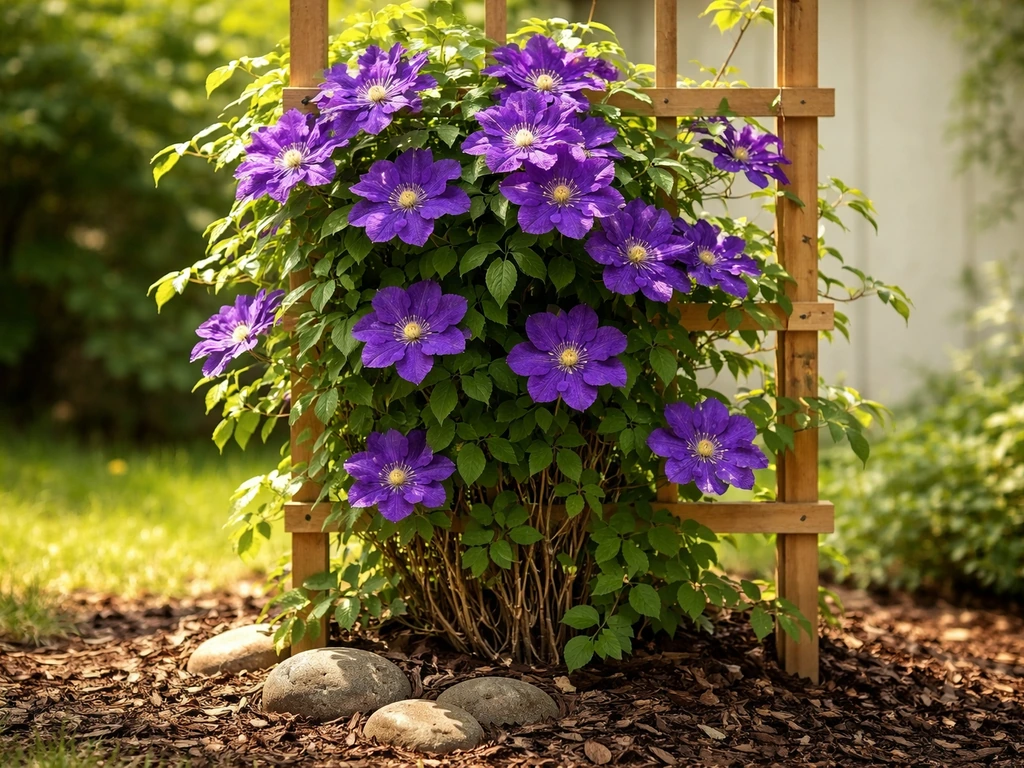
Which clematis types actually perform in Southern California
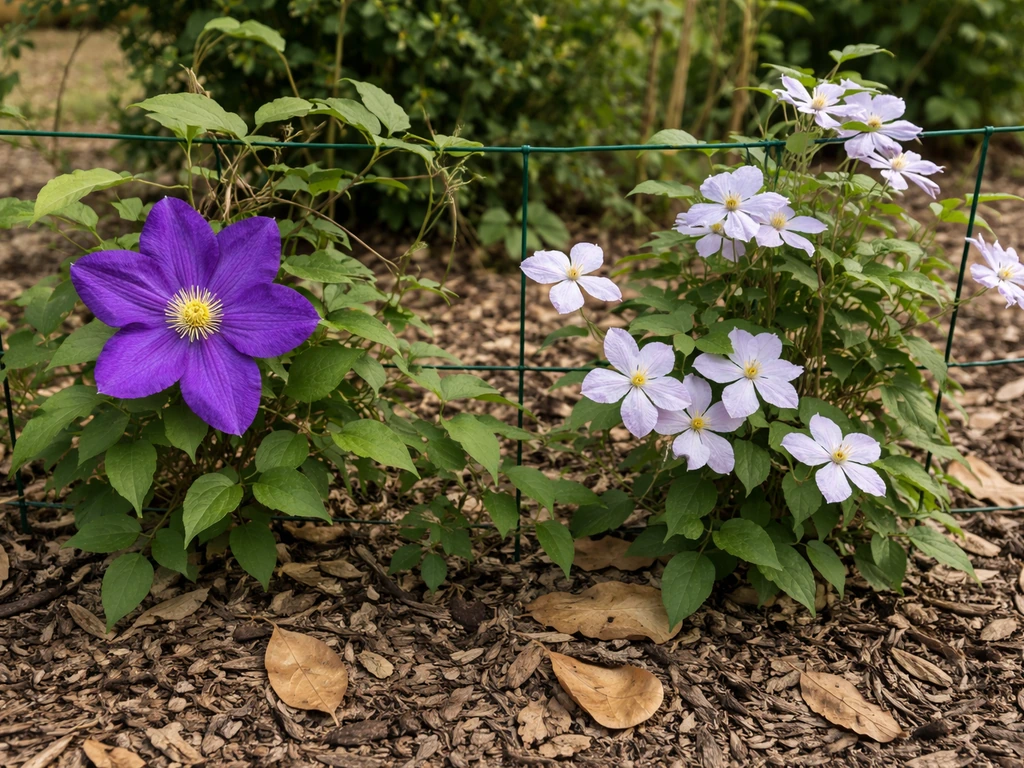
Not all clematis handle Southern California's climate equally. The large-flowered hybrid varieties (think the classic 'Jackmanii' or 'Nelly Moser') are crowd favorites, but they are also the most finicky about heat. They can absolutely bloom beautifully here, but they need more careful siting than the tougher species types.
The real workhorses for SoCal are the smaller-flowered species clematis and their close relatives. Clematis armandii (evergreen clematis) is one of the most reliable performers here. If you are wondering, “Will clematis grow in Arizona?”, choosing a reliable, heat-tolerant type like this is usually the best starting point Clematis armandii. It blooms in late winter to early spring with sweetly fragrant white flowers, stays green year-round, and handles the heat with far more grace than the big hybrids. Clematis lasiantha (the California native) and Clematis ligusticifolia are similarly tough and adapted to the dry-summer Mediterranean pattern that defines SoCal's climate. If you want something that blooms reliably without a lot of fuss, start with one of these.
Among the hybrids, earlier-blooming varieties tend to do better than the ones that peak in the hottest part of summer. Varieties that flower heavily in spring and then rebloom lightly in fall sidestep the worst of the summer heat entirely. Look for Group 2 hybrids (more on those below) if you want that repeat-bloom pattern. Group 3 types like 'Jackmanii' bloom on new summer growth and can struggle when that growth is stressed by inland heat, though they often bounce back with a strong fall flush when temperatures drop.
Climate and site conditions: coastal vs. inland, sun, and wind
The single most important site factor for clematis in Southern California is afternoon shade. Clematis thrives on a principle that gardeners sometimes call 'cool roots, warm tops.' The foliage and flowers want sun, ideally 4 to 6 hours of direct light per day, but the root zone needs to stay cool. When you have blazing afternoon sun hitting the base of the plant and the surrounding soil, clematis wilts, stops flowering, and eventually declines. In SoCal, that means east-facing or north-facing exposures are often better choices than full-south or west-facing walls.
Coastal SoCal (roughly within 10 to 15 miles of the ocean) is legitimately good clematis country. The marine layer keeps summer highs reasonable, frost is rare, and the mild winters give the vine just enough of a rest period to bloom well the following season. If you are gardening in Pacific Palisades, Encinitas, or Ventura, you can grow a much wider range of clematis with less intervention.
Inland areas like the Inland Empire, Antelope Valley, or the hotter parts of the San Gabriel Valley are a different story. Summers regularly hit 100 to 110 degrees Fahrenheit, and the dry Santa Ana winds in fall and spring can desiccate clematis almost overnight. In these spots, your best strategy is to plant on the east side of a structure so the vine gets morning sun and afternoon shade, mulch the root zone heavily, and pick heat-tolerant species types over large-flowered hybrids. Wind is a genuine threat too: clematis vines have slender stems that snap in strong gusts, so a windbreak or sheltered fence corner makes a real difference.
Planting and placement: containers, in-ground, soil, and support
In-ground vs. container growing
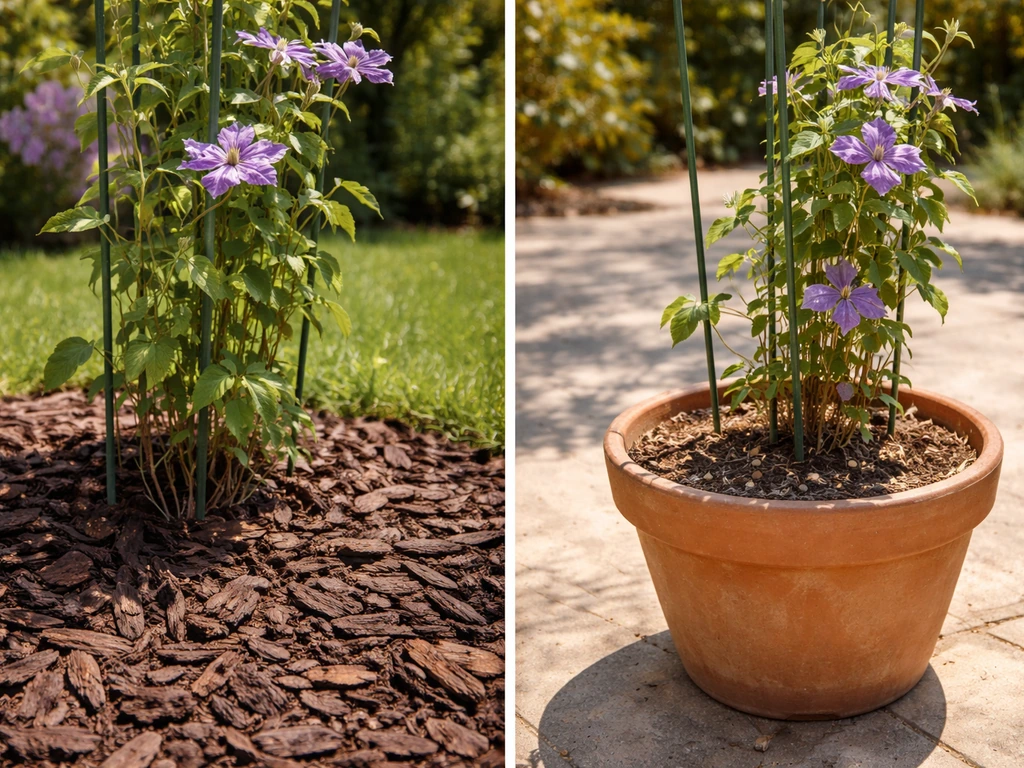
In-ground is generally better for clematis in SoCal because containers heat up fast in summer and dry out quickly, which is the opposite of what clematis roots want. That said, containers work well on shaded patios or balconies where you can control watering closely and keep the pot out of full afternoon sun. If you go the container route, choose a large pot (at least 15 to 18 inches wide) in a light color to reflect heat, and expect to water daily or even twice daily in hot inland summers.
When planting in the ground, the International Clematis Society recommends blank" rel="noopener noreferrer">burying the crown at least 2 inches below the soil surface, and going deeper (3 to 4 inches) if your spot gets wind or intense heat. Fuchsia can also be grown in the ground in mild climates, but it needs the right site conditions and soil to thrive can fuchsia grow in the ground. This deeper planting protects the crown and gives the vine a better chance of recovering if the top growth gets stressed or damaged. Dig a hole wide enough to spread the roots without crowding them, and amend the soil with compost to improve drainage. SoCal soils tend to be clay-heavy or sandy depending on the area, and both extremes benefit from compost amendment.
Keeping roots cool
To keep the root zone cool, plant a low-growing groundcover or place flat stones or pavers around the base of the vine. A 3- to 4-inch layer of organic mulch (wood chips or shredded bark) works well and also conserves moisture between waterings. Some SoCal gardeners plant a small shrub nearby specifically to shade the clematis crown without competing too aggressively for water. Lavender or a compact salvia works nicely for this.
Support and trellis
Clematis clings by wrapping its leaf stems around supports, so the structure you provide needs to be something the vine can actually grab. Thin wire (1/8 to 1/4 inch), bamboo stakes, or a trellis with openings no wider than about 3 inches works well. Heavy lattice with wide openings is harder for clematis to climb on its own. Position the trellis an inch or two away from a wall or fence to allow airflow behind the vine, which reduces fungal disease risk in humid coastal areas.
Why clematis struggles in SoCal and how to fix it
The most alarming thing that can happen to your clematis is watching healthy stems suddenly collapse and turn black within a day or two. This is clematis wilt, a fungal disease that causes affected stems and leaves to die rapidly. It looks catastrophic but usually is not fatal. The best response is to cut the affected stems back to healthy tissue (or even to the ground), dispose of the cuttings (do not compost them), and wait. Most established clematis will push new growth from below the soil surface if the crown is healthy and buried deep enough.
Heat stress looks different. It shows up as bleached-out flowers, wilted foliage that does not recover overnight, and a vine that stops putting out new growth in midsummer. The fix is almost always shade and water. Add a shade cloth over the vine during the hottest weeks, increase watering frequency, and mulch more heavily around the base. In most cases, a heat-stressed clematis will recover and put on a strong flush in September and October when temperatures drop.
Poor blooming is the third common complaint, and the cause is almost always one of three things: too much shade, wrong pruning timing, or a vine that has not been in the ground long enough. Clematis typically takes 2 to 3 years to establish and bloom heavily. Pruning at the wrong time (cutting off the buds before they open) is a surprisingly common mistake, which is exactly why understanding pruning groups matters before you ever pick up the shears.
A simple SoCal care calendar and pruning group guide
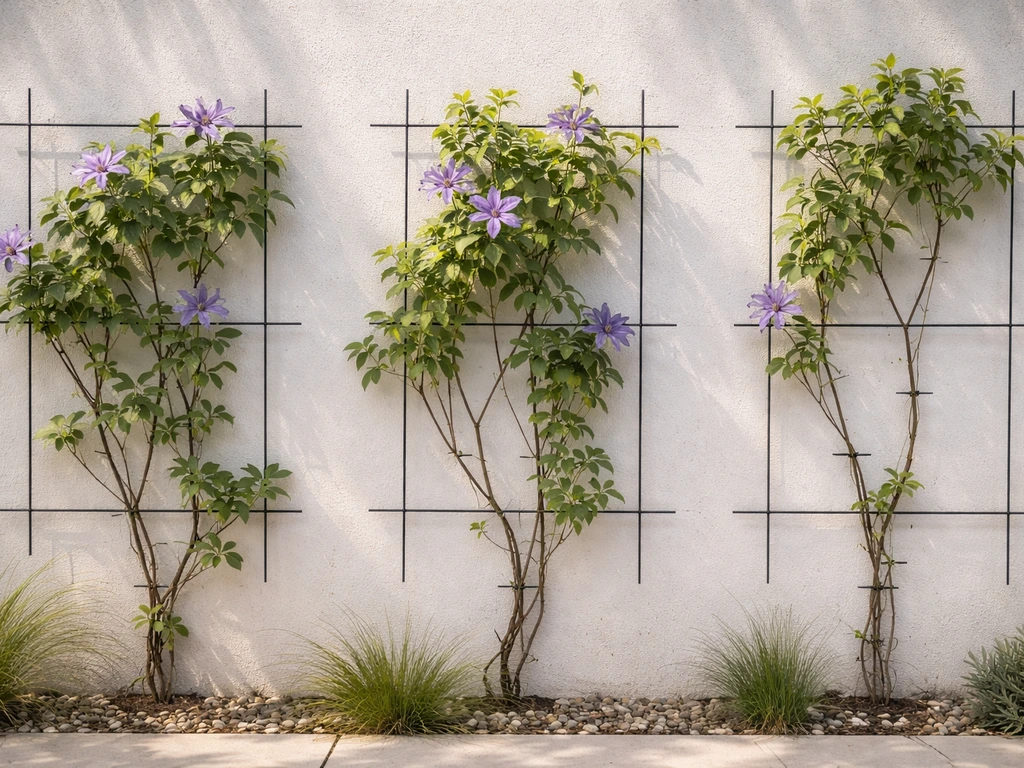
Clematis is sold in three pruning groups, and the group determines when and how hard you cut the vine back. Getting this wrong is the fastest way to eliminate a season of flowers.
| Pruning Group | When It Blooms | When to Prune | SoCal Notes |
|---|---|---|---|
| Group 1 | Late winter / early spring on old wood | Right after flowering; light tidy only | Includes C. armandii; great for SoCal; prune immediately after bloom or you remove next year's buds |
| Group 2 | Spring on old wood, then repeats on new growth | Light prune in late winter; deadhead after first flush | Best hybrid option for SoCal; gets two bloom periods, missing the peak summer heat |
| Group 3 | Summer / fall on new growth | Hard prune to 12-18 inches in late winter | Most heat-sensitive hybrids; better suited to coastal SoCal; benefits most from afternoon shade inland |
For establishment pruning, the International Clematis Society recommends cutting back young vines to about 12 inches in the second spring and to about 18 inches in the third spring. This feels harsh but encourages a dense, multi-stem plant rather than a single weak stem that sprawls without flowering.
Watering and feeding through the year
In SoCal's dry climate, consistent deep watering is essential, especially during the first two years after planting. Aim for deep, infrequent irrigation rather than light daily spritzing: water thoroughly once or twice a week in spring, and increase to every other day or more during hot inland summers. Once established, species types like C. armandii are reasonably drought-tolerant, but hybrids will need continued regular moisture.
Feed clematis in early spring with a balanced slow-release fertilizer, then switch to a low-nitrogen, higher-potassium feed (like a tomato fertilizer) in late spring to support flowering rather than just foliage. Avoid heavy feeding in summer when the plant is heat-stressed. Resume light feeding in early fall for Group 3 types that are putting on their fall bloom push.
What to look for when buying clematis in Southern California
Most SoCal nurseries carry clematis in spring, and the tag is your most important shopping tool. Here is what to check before you put the plant in your cart:
- Pruning group label: The tag should clearly say Group 1, 2, or 3 (or use equivalent terms like 'hard prune' or 'minimal pruning'). If the tag does not indicate a pruning group, ask the nursery staff or look up the variety name before buying.
- Mature size: SoCal fences and trellises vary widely, so confirm the vine's expected height (commonly 6 to 30 feet depending on variety) matches your structure.
- Bloom time: For inland gardeners, prioritize varieties listed as spring- or fall-blooming to avoid peak summer heat during the main flower period.
- Species vs. hybrid: Species types (C. armandii, C. texensis, C. viticella) are listed on the tag by their Latin name. These tend to be tougher and more heat-tolerant than the large-flowered named hybrids.
- Root system: Buy the largest, most established plant you can afford. A 1-gallon plant in a 4-inch pot will struggle; a 1- or 2-gallon plant with visible healthy roots and multiple stems gives you a much better start.
Local independent nurseries in SoCal, particularly those in coastal communities, often stock a wider range of clematis than big-box stores and can advise on what has performed well in your specific microclimate. If you are shopping in late spring and the selection is picked over, many specialty online nurseries ship bare-root clematis in late winter, which is actually an ideal planting window for SoCal gardeners. If you are exploring other warm-climate states, the experience of growing clematis in SoCal is fairly comparable to the challenges faced by gardeners in Arizona or Texas, where heat management and variety selection matter just as much.
FAQ
What is the best clematis type to start with if I live in inland Southern California?
Start with heat-tolerant species or close relatives like Clematis armandii or Clematis ligusticifolia, then choose Group 2 hybrids if you want reliable repeat bloom. In inland heat, large-flowered hybrids are more likely to stall unless the base gets real afternoon shade.
How much afternoon shade do I actually need for clematis to survive SoCal summers?
Aim for the crown and root zone to be out of harsh afternoon sun, even if the vine top receives morning light and some direct sun. If the base gets blazing sun on walls or fences, even for a few hours, expect wilting and reduced flowering.
Can I grow clematis in Southern California without a trellis or support?
Yes, but you still need a way for stems to hold and wrap. Clematis will not reliably climb on smooth surfaces like solid vinyl or painted stucco unless you add something grab-friendly (thin wire, bamboo, or a trellis with openings around 3 inches).
Does pruning for Group 2 or Group 3 work the same way in Southern California?
Use the pruning group schedule, but watch your climate timing. In SoCal, fall growth can be triggered by warm weather, so avoid heavy cutting late in the season. If you prune at the wrong time, you can lose the next bloom cycle because buds are formed earlier than many gardeners expect.
My clematis looks alive but won’t bloom for the first year or two, is that normal?
Yes. Even with correct site conditions, clematis often takes 2 to 3 years to establish before it blooms heavily. During the first season, focus on consistent deep watering and avoiding stress from full afternoon sun rather than expecting early flowers.
What should I do if only the top growth dies back in summer but the plant seems otherwise fine?
Treat it as heat stress or midseason dehydration first, then protect the crown. Increase watering frequency during heat waves, add deeper mulch, and consider temporary shade cloth. If the crown was buried correctly, you should see new growth resume when temperatures drop.
Is it better to plant clematis in the ground or a container in Southern California?
In most cases, in-ground wins because pots heat up and dry out faster. If you use a container, choose a large, light-colored pot (15 to 18 inches wide or more), keep it out of full afternoon sun, and plan on very frequent watering in inland summers.
How often should I water clematis in SoCal, and what’s the biggest mistake?
Water deeply once or twice a week in spring, then increase to every other day or more during inland triple-digit heat. The common mistake is light, frequent watering that keeps roots shallow and warm, leading to heat stress and poor flowering.
Will groundcover or stones around the base help, and could they cause problems?
They can help by shading and insulating the crown, which supports the cool roots, warm tops goal. Just avoid plants that aggressively compete for water right at the crown area, and keep mulch and moisture management consistent.
How do I tell clematis wilt apart from winter dieback or heat stress?
Clematis wilt usually shows sudden collapse and blackened stems within a day or two, then rapid decline of affected growth. Heat stress is more gradual, with wilting and bleached flowers during hot weeks, and it typically improves when shade and watering increase.
If my clematis collapses and I cut it back, do I need to sterilize tools or disinfect the plant?
Yes, handle it carefully. Cut away to healthy tissue and remove the affected material, then clean pruning tools before continuing on healthy plants to reduce spread of fungal issues. Avoid composting infected cuttings.
Is there a soil amendment I should prioritize for Southern California clay or sandy spots?
Add compost to improve drainage and consistency, since SoCal soils can swing between clay-heavy and sandy. The goal is to keep the crown stable and the root zone evenly moist but not waterlogged, which reduces decline during heat waves.